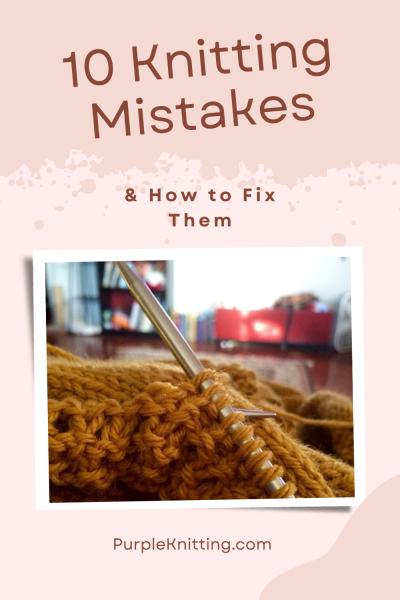
If you are just starting as a beginner or you’ve been doing this hobby for a while, common knitting mistakes happen to all of us. Sometimes they’re tiny slip-ups, like a dropped stitch, and other times they’re… well, big enough that you seriously consider frogging the whole project. Even now, after having knitted for many years, I still make these mistakes.
Mistakes in any hobby are normal. Learning how to fix knitting mistakes is a huge part of becoming a better knitter. So in this post, I will cover 10 of the most common knitting mistakes and how to avoid (or fix) them without getting upset.
Why Do Knitting Mistakes Happen?
I find most of my mishaps often occur when I am rushing or not paying enough attention. I can drop stitches if I am hurrying to finish a row before I have to go out somewhere or other, and I want to finish a certain section of the pattern.
If you are a new knitter, then you can expect to make errors; it is just part of learning a new skill.
More experienced knitters will make mistakes if they think the pattern can be done another way, or maybe they think a certain technique can be left out.
Fixing Knitting Mistakes
1. Dropped stitches
This one’s probably the most common knitting mistake.
One second, everything’s going smoothly, and the next, you look down at your work and see a stitch has slipped off the needle and is unravelling down your work. It looks somewhat like a runaway ladder that you get in tights.
How To Fix A Dropped Stitch In Knitting
First of all, don’t panic. Get a crochet hook and work the stitch back up, one row at a time. If you’re not sure how to do that, watch the video below. It’ll walk you through the steps in a super simple way.
2. Twisted Stitches
Have you ever noticed that some of your stitches look a bit odd, somewhat twisted?
Let’s understand first how a stitch should sit on the needle normally or correctly. We call this the stitch mount. When a stitch sits on the needle, normally the right-hand leg of the stitch is in front of the needle, and the left leg sits behind the needle.
When a stitch sits incorrectly, or as they say reversed, it will have the left leg of the stitch in front of the needle, and the right-hand leg will be behind the needle, giving a twisted look.
How does a twisted stitch happen?
Twisted stitches can occur when a stitch is made incorrectly ie wrong knitting technique. This can happen when you knit into the back loop of a stitch ( that is sitting correctly on the needle) instead of the front. When you do this, the stitch will be twisted to the left.
When a stitch twists, it happens because of 2 things – the way a stitch is mounted on the needle and which of the two legs you knit into.
Fixing Twisted Stitches:
- Identify the Twisted Stitch:
Observe if the stitch is sitting correctly on the needle or if it is twisted. - Correct the Stitch Mount:
Ensure the right leg of the stitch is in front of the needle before knitting into it. - Knit through the leading leg:
Always knit into the front loop of a correctly mounted stitch or the back loop of a reverse-mounted stitch.
When purling or knitting, the yarn can be wrapped around the needle in the wrong direction, resulting in a twisted stitch.
When purling, ensure the yarn is brought to the front of the work correctly. When knitting, ensure the yarn is wrapped around the needle in the correct direction.
3. Uneven Tension & Gauge
Uneven tension is the cause of your knitting work looking loose in one area and tighter in another. When you are a beginner, it takes time to get used to holding the yarn with the same tension at all times. This gets better with practice. Knitting small projects like dishcloths helps as they are quick and you get practice.
If you don’t knit a swatch and get the correct gauge with a pair of needles and yarn, then you may get to experience the frustration of a garment you’ve made not fitting as it should. Knitting a swatch is boring and it takes time. If you are making a garment that needs to fit, then you must knit a swatch and get gauge before starting the project.
If you’re not sure what gauge is all about, read this post here to learn all about it.
4. Accidental Yarn Overs or Mystery Holes
Sometimes when I knit too fast my yarn accidentally wraps over the needle between stitches and I get a hole forming where there shouldn’t be one. This can also happen if you’re switching between knitting and purling.
Fixing accidental yarn overs will not result in a perfect look because the accidental yarn over has caused an extra column of stitches. However, you can fix it so that the hole is removed. How you do this is best illustrated with a video, as it is difficult to accurately describe the technique in words.
To avoid these holes appearing, try to concentrate on where your yarn is going, especially if you are doing knits, then purls.
5. Losing Track of Stitch Count
It is easy to get comfortable with your knitting without checking until you notice something is not right. So then you check the number of stitches you should have and see, oh dear, it is not right either. A good habit to have when knitting is to check the number of stitches on your needle after each row. Yes, it does slow you down, but worth it in the long run. I hate having to unpick several rows ( called frogging ) to fix a mistake I made that resulted in the incorrect number of stitches.
6. Splitting Yarn
Some yarns tend to unravel and split. If you are not careful, it is easy to knit what should have been one stitch into two. When working with these yarn types, be careful to look at each stitch and knit them cleanly. I love the softness and natural feel of cotton yarn, but it does have a bad habit of splitting. I have learned to slow down when using it and check that all the fibres are together.
If you have noticed extra stitches from splitting yarn, you can either unpick your work if it is not too far down or knit 2 stitches together on the next row.
7. Extra Rows for Part of Your Knitting – Wrong Direction
Have you ever picked up your knitting and been a bit confused as to which way to knit? This often happens if you put your work down in the middle of a row. You then decide to knit in one direction only to find a few rows later that it looks lopsided.
This error can only be fixed by unpicking to the point of the error.
If you think logically, the last stitch you knitted before you put the needles down will be attached to the working yarn. The working yarn will be attached to the right-hand needle. So, make sure you start again like this, and you should be okay. A tip I was told many years ago was to put a stitch marker into the last stitch you worked.
8. Casting On and Off too Tightly or too Loosely
Have you ever completed a knitting project, normally something that is a fitted garment, and discovered that it does not fit correctly? For example, the neck of a sweater is finished off too tightly and you can’t pull it over your head, or it is so loose that it flops and does not sit perfectly.
The fix for this situation is to use a stretchy cast off method like Jeny’s Suprisingly Stretchy Cast off. There is a corresponding stretchy cast off technique – watch the video below to see how it is done.
9. Trying to Fix a Mistake and Making it Worse
When trying to do a complex knitting pattern, I have been in the situation where I made an error, then tried to fix it. The end result was that I then mucked it up totally. Sometimes, if you’ve made a mistake like this, it is best to admit defeat (temporarily) and rip it all out and start over.
When this happens, I have always learned a lesson as a result.
10 Running out of Yarn
Don’t make the mistake of running out of yarn, as you may struggle to get the exact matching shade. Read your pattern carefully and do the maths to figure out the amount of yarn you’ll need. Knit a swatch so you get the gauge as recommended in the pattern. It is better to overestimate the yarn you’ll need. Leftover yarn can always be used in another project.
So there you have 10 common knitting mistakes, how they happen and how to fix or avoid them in the future.
Visit the Learn to Knit category for more beginner knitting techniques and tutorials